
ThrillhouseBot
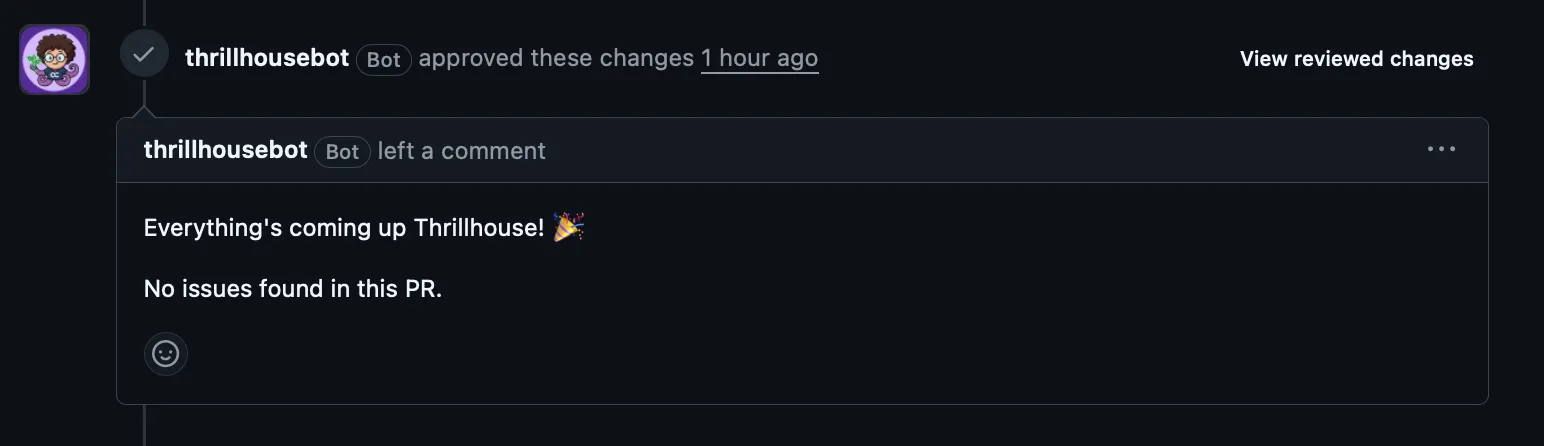
“Everything’s coming up Thrillhouse!”
A self-hosted, GraalVM-native PR review bot, built as a GitHub App with Quarkus. It reviews pull requests using any OpenAI-compatible chat API, so the review is language-agnostic and you can pick the provider that suits you — including a local Ollama model, so no code has to leave your network.
Features
Section titled “Features”- Reviews diffs for correctness, security, regressions, stale comments and code quality, and tags every finding
critical,high,mediumorlow - Reviews large pull requests whole: the diff is split into token-budgeted batches reviewed in parallel, and any file that does not fit is named
- Inline suggestions you can apply with one click
- A second pass re-checks each finding against the diff before it is posted
- Follow-up reviews track whether earlier findings were fixed, declined or are still open, and re-check a maintainer's decline against the code
- One summary comment per pull request, edited in place every round, with a risk breakdown, a changed-files walkthrough and every finding still open
- Comment commands (
/review,/summary,/describe,/changelog,/add-docs,/improve,/generate-tests,/resolve,/pause,/resume,/help, and with learnings on/learnings,/remember,/forget) and conversational replies to@thrillhousebot - Auto-review triggers: skip drafts, gate on labels, filter by base branch, and optionally space out reviews of one PR (
AUTO_REVIEW_MIN_INTERVAL) - Maintainer 👍/👎 reactions and "not useful" replies are recorded as finding feedback
- Optional review context, each off by default: the issues a PR links and their acceptance criteria, the CI checks that already failed on the head commit, patch coverage from your own coverage report, and review learnings (maintainer declines and
/rememberconventions from earlier reviews of the same repository) - Optional deterministic scan of added lines for leaked credentials and risky Terraform, Kubernetes, CloudFormation and Dockerfile settings, with no model call and every matched secret redacted
- Optional per-call review dimension routing, which sends each call only the review rules its files need
- Optional outgoing notification when a review completes or fails: JSON, Slack or Discord, HMAC-signed, metadata only unless you opt in
- Per-repository instructions in
.github/thrillhousebot.md(falling back to Copilot, Claude and Agents files) and per-repository ignore globs and path-scoped rules in.github/thrillhousebot.yml - Optional reasoning-effort setting and per-model generation and budget caps
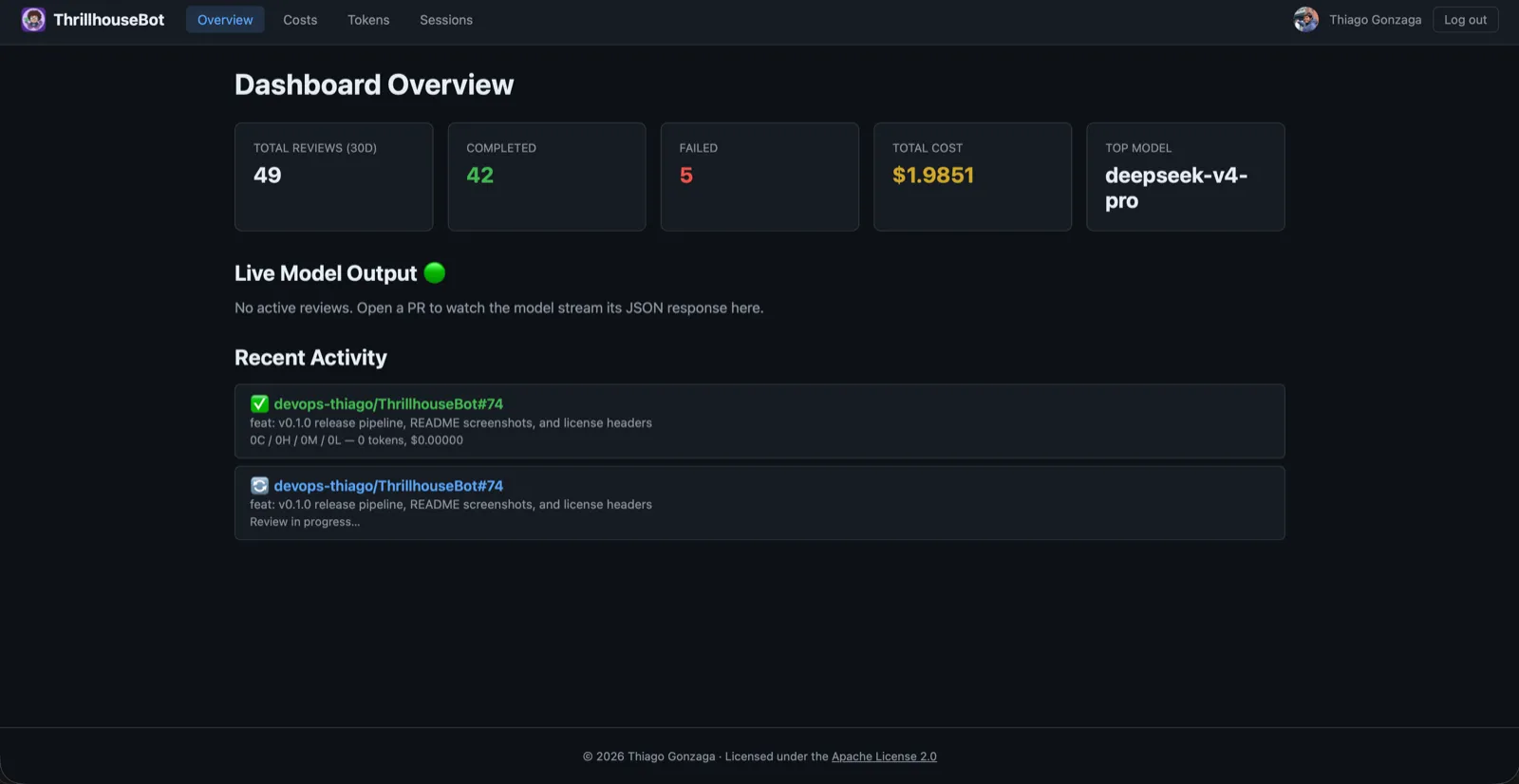
- Live dashboard (Next.js) with a WebSocket activity feed, cost charts and token tracking
- OpenTelemetry traces, token histograms, cost counters and latency metrics
Where to go next
Section titled “Where to go next”- Getting started — create the GitHub App with the hosted installer and run the bot with Docker Compose.
- Commands — drive the bot from a PR:
/review,/describe,/changelog,/add-docs,/improve,/generate-tests, and more. - Configuration — every environment variable, with defaults.
- AI providers — point the bot at the OpenAI-compatible endpoint of your choice.
- Architecture — how a review flows through the system.
- Finding feedback — maintainer 👍/👎 capture, and how it differs from review learnings.
- How it compares — an honest look at where ThrillhouseBot sits next to other AI code-review tools.
- Contributing — development setup and the CI bar.
Dashboard
Section titled “Dashboard”The built-in dashboard (Next.js, served by the bot itself) shows summary cards, a live activity feed that streams the model’s output as a review runs, cost charts by model, token breakdowns, and a paginated session history:
Community and license
Section titled “Community and license”Questions and setup help belong in GitHub Discussions; bugs and feature requests in Issues.
Licensed under the
Apache License 2.0
(SPDX: Apache-2.0).